
Review · ROME
From Rome: Ostia Antica Guided Half-Day Trip by Train
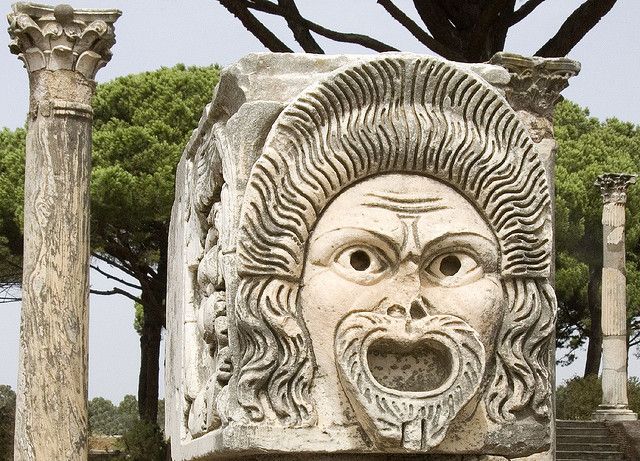
Ostia Antica gives you something Rome itself often cannot: room to picture ordinary life. This former port city has taverns, warehouses, apartment blocks, baths, mosaics, and a communal toilet, all spread along ancient streets. I especially like the small group of up to 12 and the easy train ride from Piramide.
The Baths of Neptune and their sea-god mosaic are a highlight, while the amphitheater and public washrooms add the human details that grand monuments miss. Guides such as Rob, Cat, Alberto, Laura, and Caterina are praised for lively storytelling and good pacing. The main drawback is that the site is large, exposed, and uneven, so you need comfortable shoes and some stamina.
Key points to know before you go
- See everyday Roman life: Taverns, shops, warehouses, baths, apartments, and public washrooms make this more than a parade of temples.
- Ride from Rome by train: The tour begins at Cafe Piramide and includes return rail tickets, with the guide leading the outward journey.
- Expect a three-hour site walk: You visit the Decumanus Maximus, Baths of Neptune, amphitheater, Forica, and other major remains.
- Benefit from a small group: A maximum of 12 people makes it easier to hear the guide and ask questions.
- Plan for extra time: You can remain at Ostia Antica, explore modern Ostia, or continue to a nearby beach after the guided portion.
- Bring practical gear: Wear sturdy shoes, carry water and sun protection, and pack beachwear and a towel if you plan to continue to the coast.
Why Ostia Antica is one of Rome’s best half-day outings
Ostia was Rome’s ancient harbor town, founded in the 4th century BC. It helped supply the capital with food and goods, and at its height it was home to more than 100,000 people. That role matters because the ruins show Rome from street level, not just from the viewpoint of emperors and generals.
You walk through the old city on the main Decumanus Maximus, a long thoroughfare lined with buildings and statues. The remains include thermal baths, theaters, taverns, warehouses, apartment buildings, and commercial spaces. Many walls still rise high enough to give you a sense of the original streetscape.
I like Ostia because it answers practical questions. Where did people shop? Where did workers gather? How did residents use public baths? What did a port city need to keep running? Pompeii is better known, but Ostia can feel quieter and less crowded. Several experienced visitors compared the two sites favorably, with some preferring Ostia because the open ruins allow a calmer visit.
The site is not a quick stroll past a few famous monuments. It is broad, and its meaning can be hard to grasp without help. A guide gives you a route through the most important sections and explains what you are seeing before the details blur together.
More Train Day Trips in Rome
- Ancient Ostia Antica Semi-Private Day Trip from Rome by Train with Guide
★ 4.5 · 579 reviews - Venice Day Trip from Rome by High-Speed Train with Happy Hour
★ 4.5 · 445 reviews - From Rome: Day Trip to Venice by High-Speed Train
★ 4.6 · 352 reviews
Meeting at Cafe Piramide and taking the train
The meeting point is Cafe Piramide at Piazzale Ostiense, 9. When you face the Piramide Metro station on Line B, the cafe is on your right, near the train tracks and station exit. Look for the white umbrellas outside and a City Wonders sign.
This is a practical location, but give yourself time to find it. The station area can be busy, and one useful orientation detail is that the cafe is close to the metro exit, not across the street. If you arrive by Metro from Termini, allow extra time for the journey and crowds.
Your guide provides the return train ticket and leads the group to Ostia Antica. The outward ride takes about 15 minutes in the stated schedule, while the return journey is listed at about 20 minutes. The short trip is one of the tour’s biggest advantages. You avoid arranging a taxi or navigating the route alone, yet you still get the sense of leaving central Rome for a very different setting.
The guide keeps track of the group during the outward journey and explains what will happen at the site. Guides including Rob and Laura have been praised for making the transport simple, especially for families and first-time visitors to Ostia.
The first view of the archaeological park
From the Ostia Antica station, the archaeological site is less than a five-minute walk away. That short connection keeps the outing efficient, although the total activity still takes around four hours.
The ancient city opens up as a large outdoor archaeological park. You will be walking on old roads and uneven ground, with little shade in some sections. In warm weather, this matters. Alberto has been singled out for finding shaded places during hot tours, but you should still bring water, a hat, and sun protection rather than count on shade.
The guide-led visit lasts about three hours. That leaves enough time to cover the main sights without racing from one photo stop to another. Rob has been praised for using short breaks and giving the group time to look around independently. The exact route can vary, but the aim is to show the key buildings while helping you understand how the city functioned.
Walking the Decumanus Maximus
The Decumanus Maximus is the natural spine of the visit. Walking along it gives you a strong sense of the city’s scale and layout. Instead of viewing ruins as isolated fragments, you see how streets connected homes, businesses, public buildings, and religious spaces.
Roman statues line parts of the walkways, and the surviving walls help you imagine buildings that once rose above the street. One useful feature of Ostia is that some structures retain enough height to suggest multiple levels. You can better picture a working city rather than a flat field of foundations.
The guide’s storytelling is most valuable here. A bare wall tells you very little. A clear explanation of its use, location, and connection to nearby buildings turns it into part of a larger picture. Guides Rob, Cat, Alberto, Laura, and Caterina have all been praised for bringing daily life into the walk through anecdotes, images, humor, and occasional acting.
That style suits Ostia. The site is large enough that a strictly academic talk could become tiring, while a purely entertaining tour would miss the archaeology. The best guides balance both, keeping the group moving while stopping at the places that deserve more time.
More rail and cable car day trips around Rome:
- From Rome: Pompeii and Naples Day Trip by High-Speed Train
★ 4.7 · 234 reviews - From Rome: Positano & Amalfi Coast Day Trip by Train & Ferry
★ 4.6 · 225 reviews - From Rome: Day Trip to Florence by High-Speed Train
★ 4.7 · 44 reviews - From Milan: Bernina Train and St. Moritz Day Trip
★ 4.5 · 4,495 reviews
The Baths of Neptune and their sea-god mosaic
The Baths of Neptune are among the most memorable stops. Their surviving mosaic shows Neptune, the sea god, being drawn by a four-horse chariot. It remains striking because it connects the decoration to the city’s maritime identity.
This is a good place to slow down. Look at the mosaic as art, but also think about the role of public baths in Roman society. Baths were not simply places to wash. They were social and communal spaces, part of the daily rhythm of urban life.
The guide helps you read the building and mosaic together. Without that context, you might admire the picture and move on. With an explanation of how the baths fit into the town, the stop becomes a window into public life.
The mosaics across Ostia are a major reason to bring a guide. Some are easy to spot, while others are worn or require you to understand what the original room was used for. The site’s preservation is impressive, but it is not arranged like a modern museum with labels at every turn.
The amphitheater and the 3,500-seat crowd
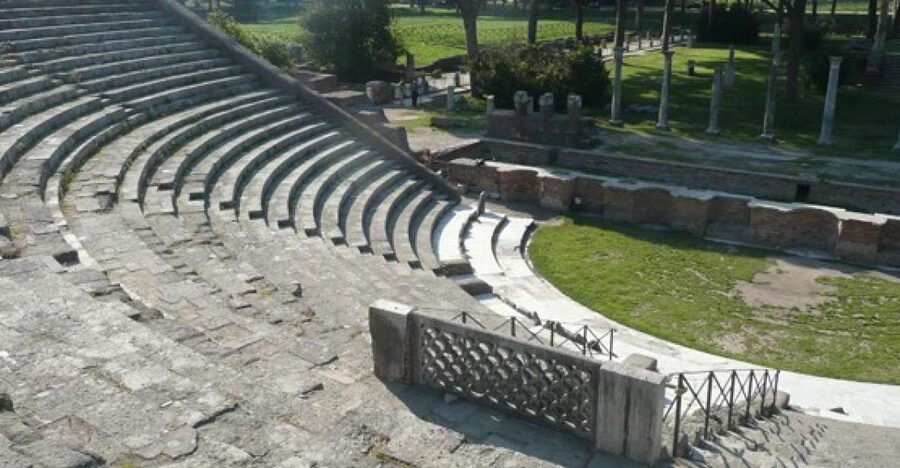
Ostia’s amphitheater gives you a chance to sit where about 3,500 spectators once watched performances. It was first built in 12 BC, and its shape remains clear enough for you to understand how the audience was arranged around the central space.
This stop works because it is physical. You can take your place in the seating area and look across the arena. The guide can explain the building’s purpose and help you imagine the noise and movement of a public event.
The amphitheater is not the largest Roman arena you will see in Italy, but that is part of its appeal. Its size feels more local and intimate. You can picture a town audience rather than an imperial capital hosting a huge spectacle.
The route may include short pauses here and elsewhere. Those breaks are useful because three hours of walking among exposed ruins can wear you down, particularly in summer. Ask questions when the group pauses, since a small party makes conversation easier.
The Forica and the ordinary side of Rome
The communal Forica is one of Ostia’s most memorable and slightly comic stops. It is a large open room with a marble bench and 20 well-spaced holes arranged along four walls. You can sit briefly and experience one of the least glamorous but most revealing parts of Roman urban life.
This is exactly the sort of detail that makes Ostia valuable. Monumental Rome can give you emperors, armies, and grand architecture. The Forica reminds you that ancient cities also needed toilets, drains, shops, kitchens, storage rooms, and places for workers to gather.
The stop is handled with humor, but it also has real historical value. It shows how much of Roman life happened in shared public spaces. You get a clearer picture of the people who used the city, not just the officials who built it.
Taverns, warehouses, and a working port
Ostia was a commercial and military port, so the warehouses and business areas help explain why Rome needed the town. Goods passed through here before reaching the capital. The remains of taverns and commercial buildings make the old port feel practical and busy, even when the ruins are quiet today.
I find this side of Ostia more revealing than another isolated monument. You can see how an ancient city was organized around work. Storage, trade, food, bathing, entertainment, and housing were close together because daily life depended on all of them.
Some walls and decorative remains are well preserved, while other areas require more imagination. This is where your guide earns the fee. A clear explanation of what each space did can save you from walking past an important building without realizing it.
The guided tour focuses on the major highlights, not every corner of the park. That is sensible for a half-day visit. You see enough to understand the town, then have the option to continue alone if you want a longer look.
Staying after the tour: ruins, museum, town, or beach
The guided service ends in Rome at Piramide at about 1:00 PM if you return with the group. You are also free to remain at Ostia Antica after the tour. Your return ticket is provided, but the later journey back is unescorted, so listen carefully to the guide’s directions.
Staying longer makes sense if you want to explore beyond the main route. The archaeological park is large, and the guide cannot cover every street in a three-hour visit. A museum is also located inside the site. Opening arrangements can vary, and one winter visit found it closed early at about 1:30 PM, so check the current schedule if the museum matters to you.
You can also continue to the modern town of Ostia or a nearby beach. Pack a towel, beachwear, and sports shoes if you plan to add the coast. This option gives the outing a flexible finish, but remember that the guided service does not escort you back if you stay behind.
Is the $58 price good value?
At $58 per person, the tour is reasonably priced for a four-hour experience that includes the return train ticket, archaeological entry, and an English-speaking guide. You are not paying only for transportation. The main value is the route and interpretation at a site where the scale can otherwise be confusing.
A self-guided visit may cost less, but you would need to arrange the transport, buy entry, learn the layout, and decide which parts deserve your limited time. At Ostia, that last task is not minor. The ruins cover a broad area, and the right explanation can change a pile of masonry into a recognizable shop, bath, or public building.
The small group also matters. With no more than 12 people, you can usually hear the guide and ask questions without shouting. The strongest praise has gone to guides such as Rob, Cat, Alberto, Laura, Caterina, and Angellina for their clarity, humor, care with logistics, and ability to make the ancient city understandable.
The price is less attractive if you plan to stay only briefly or dislike guided sightseeing. You also need to accept the fixed meeting time and walking pace. For most first-time visitors, though, the included transport and expert explanation make the fee fair.
Who should book this Ostia Antica tour?
I recommend it most strongly if you have already seen central Rome’s major monuments and want a different view of Roman life. It is also a smart choice if Pompeii is not part of your itinerary but you want a substantial ancient city outside the capital.
History fans, architecture students, curious families, and anyone interested in ordinary urban life will get the most from it. Children may enjoy the amphitheater, street plan, baths, and Forica, while the guide’s stories help keep the long walk from becoming a list of dates.
The outing is less suitable if you use a wheelchair, since the activity is not suitable for wheelchair users. Baby strollers are not allowed. Anyone with limited walking ability should consider the uneven outdoor setting and three-hour guided route before booking.
Wear comfortable walking shoes. Sports shoes are specifically useful if you continue toward the beach. Bring a snack or drink money for the scheduled toilet and refreshment break, and carry water even though a snack bar is available.
Should you book it?
Book this tour if you want to understand how Romans lived, worked, bathed, traded, and relaxed, rather than only seeing imperial monuments. Ostia Antica is close to Rome, easy to reach by train, and often far calmer than the city’s headline attractions.
Choose it with the guide-led format if this is your first visit. The ruins are too broad for a quick, casual wander, and the best guides turn the Decumanus, baths, amphitheater, and Forica into a connected story.
Skip it only if your schedule is too tight for four hours, you want a fully independent visit, or uneven walking is a serious problem. For everyone else, this is a smart half-day addition to Rome, especially if you can stay afterward for the museum, more ruins, modern Ostia, or the beach.
FAQ
How long does the Ostia Antica tour take?
The activity lasts four hours. The guided visit at Ostia Antica takes about three hours, with train travel included.
Where does the tour meet in Rome?
Meet at Cafe Piramide at Piazzale Ostiense, 9. It is on the right when facing the Piramide Metro stop on Line B, near the train tracks and station exit.
How do I recognize the meeting point?
Look for the cafe with white umbrellas outside. The guide will have a City Wonders sign showing the tour name.
Is the train ticket included?
Yes. A return train ticket from Rome to Ostia Antica is included in the price.
Is the return journey guided?
The guide accompanies the group to Ostia, but the return journey is unescorted if you stay after the tour. If you return with the group, the service ends at Piramide Metro Station at about 1:00 PM.
What will I see at Ostia Antica?
The route includes the Decumanus Maximus, Baths of Neptune, amphitheater, communal Forica, taverns, warehouses, thermal baths, theaters, statues, and other archaeological remains.
Can I stay at Ostia Antica after the guided tour?
Yes. You can remain at the archaeological site, visit the modern town of Ostia, or continue to a nearby beach.
What should I bring?
Bring comfortable shoes, sports shoes, a towel, and beachwear if you plan to go to the beach. You should also prepare for a long outdoor walk.
Is the tour suitable for wheelchair users or baby strollers?
No. The activity is not suitable for wheelchair users, and baby strollers are not allowed.
More Rail Day Trips around Rome
- Bangkok: Damnoen Saduak, Train Market & Mahanakhon Day Trip
★ 4.7 · 2,162 reviews - From Munich: Salzburg Day Trip by Train
★ 4.7 · 1,547 reviews - Day Trip to Bangkok Floating Market & Maeklong Railway
★ 5.0 · 1,528 reviews - London: South Downs White Cliffs Day Trip with Train Tickets
★ 4.9 · 1,441 reviews
Just added around Rome
- Day trip Rome by car : Tivoli Unesco Villa D’este & Hadrian★ 5.0 · 56 reviews
- From Rome: Hadrian’s Villa & Villa d’Este Day Trip & Lunch★ 4.5 · 157 reviews
- Day Trip from Rome: Explore Pompeii & Sorrento Amalfi Coast★ 4.8 · 160 reviews
- Sorrento & Pompeii Day Trip from Rome Audio Guide Tour★ 4.2 · 50 reviews
- From Rome: Positano & Amalfi Coast Day Trip by Train & Ferry★ 4.6 · 225 reviews
- From Rome: Ponza Island Day Trip with Boat Excursion★ 4.7 · 278 reviews
- From Rome: Sorrento, Positano & Amalfi Coast Day Trip★ 4.5 · 340 reviews
- From Rome: Pompeii and Vesuvio Guided Day Trip with Lunch★ 4.3 · 126 reviews
Train & Cable Car Day Trips, compared.
From Milan: Bernina Train and St. Moritz Day Trip
Read our review →
Salzburg Sightseeing Day Trip from Munich by Rail
Read our review →
Bangkok: Damnoen Saduak, Train Market & Mahanakhon Day Trip
Read our review →

Day Trip to Bangkok Floating Market & Maeklong Railway
Read our review →
Krakow: Zakopane, Funicular, Cheese, and Highland Day Trip
Read our review →
London: South Downs White Cliffs Day Trip with Train Tickets
Read our review →
Delhi to Agra and Taj Mahal Private Day Trip by Express Train with Lunch
Read our review →Browse the lists this tour appears in