Review · ROME
Ancient Ostia Antica Semi-Private Day Trip from Rome by Train with Guide
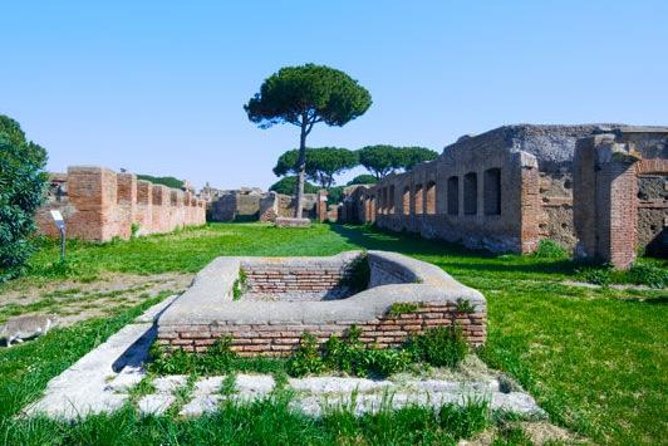
Ostia Antica gives you something Rome’s grand monuments often miss: a close look at ordinary Roman life. This former port city has streets, shops, apartments, baths, temples, and taverns still laid out where people used them, and the train ride from Rome is refreshingly simple.
I like the way this tour handles a huge archaeological site without leaving you to guess where to go. I also like the small group, capped at 12, and the fact that train fares and admission are included. The main catch is the walking: expect uneven ground, stairs, sun, and about two and a half hours on your feet.
Key points to know before booking
- A real Roman city, not just a single monument: See the Decumanus Maximus, Baths of Neptune, theater, shops, apartments, temples, and public facilities.
- Easy rail connection from Rome: Meet near Piramide metro station, ride with your guide, and return to the same meeting area by train.
- Small-group format: A maximum of 12 people allows more questions and a calmer pace than a large coach excursion.
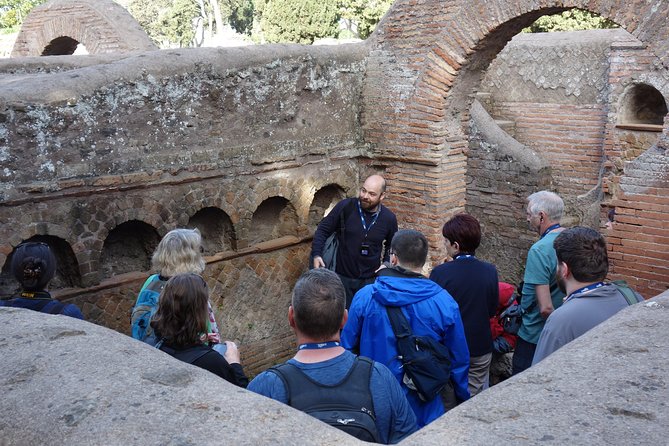
- Guides make the ruins readable: Alberto, Cat, Rob, Laura, Barbara, and Eduardo have received especially strong praise for clear storytelling and warm group management.
- A practical Pompeii alternative: Ostia is much closer to Rome and fits into a four-hour half-day outing.
- Plan for physical effort: Uneven paths, stairs, heat, and sustained walking can be difficult if you have limited mobility.
Why Ostia Antica feels different from Rome
Rome can make ancient history feel monumental and distant. At Ostia Antica, it comes down to street level. You walk along an old road, pass doorways and storefronts, and see how a Roman town was arranged for work, worship, bathing, shopping, and entertainment.
Ostia began as a port city connected to Rome and eventually grew to more than 100,000 residents. The ruins reach back as far as the fourth century BC, with later Roman construction creating the broad urban setting you see today.
The comparison with Pompeii is useful, but only up to a point. Ostia is not a smaller copy of Pompeii. Its strength is the sense of a complete working town near Rome, with a particularly good mix of public buildings and modest spaces where people lived and worked.
That makes this a good choice if you want more than emperors, gladiators, and famous temples. You get a better feel for the routine side of Roman civilization, including the streets people walked, the shops where they traded, and the communal baths where they spent time.
More Private Day Trips in Italy
- Private Tour: Pompeii and Positano Day Trip from Rome
★ 4.5 · 74 reviews - Private Tour: Day Trip to Florence and Pisa from Rome with Lunch
★ 4.0 · 65 reviews - Private Day Trip Rome to Pompeii & Amalfi Coast tickets included
★ 5.0 · 61 reviews
Meeting near Piramide and taking the train
The tour begins at Piazza Ostiense, near the Piramide metro station. You meet your English-speaking guide there, receive the round-trip train ticket, and travel together toward Ostia Antica.
This arrangement is one of the tour’s practical strengths. You do not need to work out the rail connection alone, wonder which station to use, or arrive at the archaeological park without knowing where to begin. Your guide also gives you company during the trip, which helps the outing feel like one connected experience rather than separate transport and sightseeing tasks.
The return journey follows the same general route, and the activity ends back at the meeting point. Hotel pickup and drop-off are not included, so you need to reach Piazza Ostiense independently.
Give yourself enough time to find the meeting place. One useful tip is to check your messages on the morning of the tour and arrive roughly 20 minutes early. The exact instructions matter here, especially in a busy city where a few minutes spent searching can make the start stressful.
The train ride is part of the appeal. You leave central Rome behind and see a less polished, more local side of the metropolitan area before reaching the archaeological site. This is not a luxury transfer, but it is an efficient and authentic way to get out of the center.
Walking the Decumanus Maximus
Once inside the Parco Archeologico di Ostia Antica, the guided visit lasts about 2.5 hours. The site is large enough to overwhelm first-time visitors, so the guide’s route matters.
The Decumanus Maximus is the natural backbone of the visit. This main road runs through the ancient town and helps you understand how the different parts fit together. Rather than looking at isolated stones, you can follow the line of the city and imagine people moving between shops, homes, baths, religious buildings, and public entertainment.
Your guide interprets what you are seeing as you go. The best guides connect architecture to daily behavior, explaining not only what a building was called but how it functioned. Alberto, Cat, Rob, Laura, Barbara, and Eduardo have been particularly praised for clear explanations, humor, patience, and the ability to make Roman life understandable for families and first-time archaeology visitors.
That said, guide quality can vary. A few people have found the presentation flat or too fast, and one account describes a guide failing to adjust to a visitor with a knee problem. This is a group tour, not a private visit, so speak up early if you need a slower pace or an extra moment to catch up.
The Baths of Neptune and their remarkable mosaic
The Baths of Neptune are among the tour’s most memorable stops. Their name comes from the striking mosaic showing Neptune, the Roman god of the sea, behind a four-horse chariot.
The mosaic gives you more than a pretty photo. It connects the town to its port function and shows how decoration, religion, and civic identity could come together in a public bathing complex. Your guide can help you notice the scale and layout rather than simply moving past the artwork.
Roman baths were not just places to wash. They were social spaces and part of urban life. Seeing them in the setting of a full town helps you understand how public facilities shaped the daily rhythm of Roman communities.
Bring water and dress for the conditions. Reviews describe very hot days, including temperatures around 95 degrees, and the open ruins provide limited shade in places. Some guides make a point of stopping in cooler spots and showing the group where to refill water bottles, but you should still arrive prepared.
Same base, a completely different day out:
- From Rome: Pompeii, Amalfi Coast, and Sorrento Day Trip
★ 4.6 · 7,031 reviews - From Rome: Pompeii, Amalfi Coast and Positano Day Trip
★ 4.6 · 6,620 reviews - Pompeii, Amalfi Coast and Positano Day Trip from Rome
★ 4.5 · 6,250 reviews - Pompeii and Mount Vesuvius Day Trip from Rome with Pizza Lunch
★ 4.5 · 6,151 reviews
Sitting in the ancient amphitheater
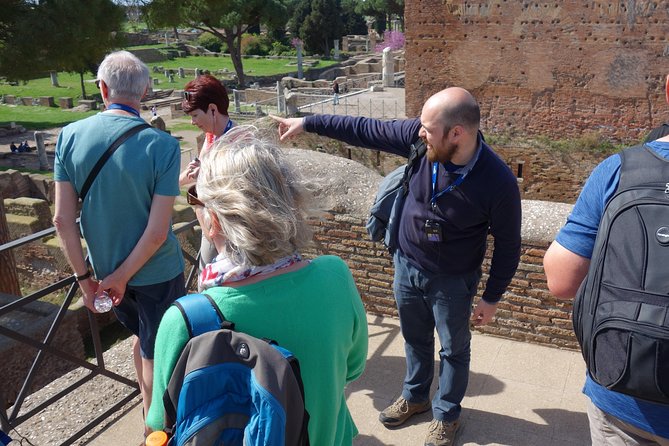
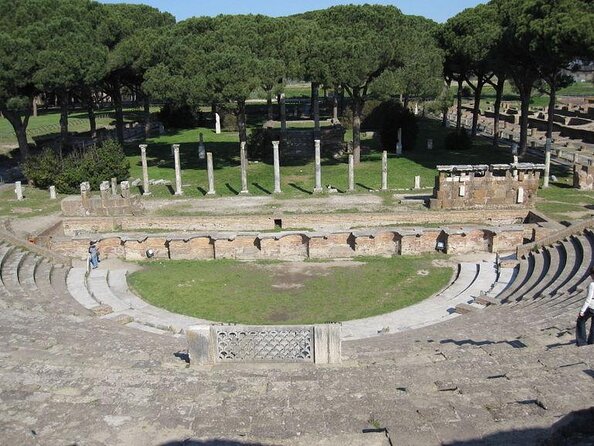
The amphitheater dates to 12 BC and once held about 3,500 spectators. It is not on the scale of Rome’s Colosseum, but its smaller size makes it easier to grasp as a neighborhood venue.
You can take a seat and look across the structure from the same general space where ancient audiences gathered. This is one of those moments when the ruins become less abstract. The theater was not only a grand symbol. It was a place where people came together for entertainment close to home.
The amphitheater also provides a useful pause in the walking route. Depending on the day and the group’s pace, your guide may use it to explain local public life and how the town’s buildings worked together.
The site can be quiet compared with Rome’s most famous monuments. That calmer setting is a major reason to choose Ostia Antica. You have more room to look, listen, and take photographs without the constant crush found at central Roman attractions.
Shops, apartments, taverns, and the Forum of the Corporations
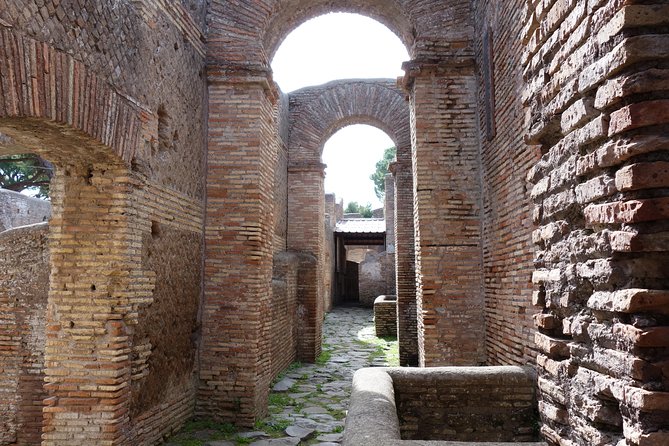
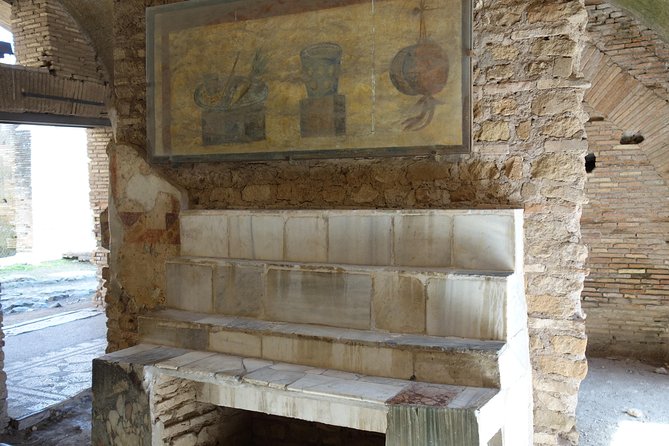
The smaller buildings may be the most revealing part of the visit. Ruined shops, apartments, and taverns show you a city designed for work and home life, not only grand ceremony.
You can see how commercial spaces faced the streets while living quarters occupied the same urban fabric. The remains of taverns and business areas help turn the town into a place of transactions and conversations rather than a collection of impressive ruins.
The Forum of the Corporations and the Collegiate Temple add another layer. Together with the public baths and theater, they show how trade, religion, politics, and leisure operated within the same compact city.
Some structures are better preserved than others, and not every stop will be equally easy to read without explanation. That is where a good guide earns the fee. The strongest guides use the walls, doorways, mosaics, and street plan to tell you what you would otherwise miss.
At the end of the guided route, you may have the chance to continue looking around, including the museum, rather than leaving the moment the formal tour ends. Confirm the timing with your guide, since the scheduled experience remains approximately four hours overall.
What the four-hour format really gives you
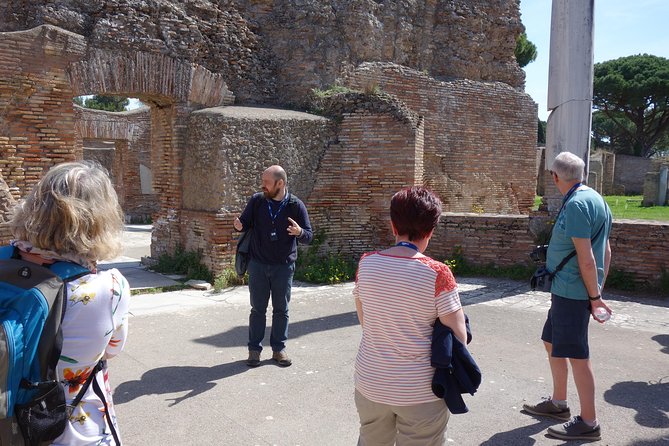
This is a half-day outing, not a complete archaeological study. You get a guided route through the most important parts of Ostia Antica, but the site is large enough that you could spend much longer exploring it independently.
That limitation is also useful. If you are traveling with teenagers or family members who are unsure about archaeology, a focused 2.5-hour walk gives you the main story without turning the day into an endurance test. One family found the length right for two teenagers, while still wishing there had been more time to explore.
The tour moves at a moderate pace, but you should not confuse that with easy walking. Expect a lot of standing and walking over rough surfaces. If you have a knee, balance, or mobility concern, contact the provider before booking and be ready to tell the guide what pace you need.
The site’s open setting means weather matters. The activity can be canceled in poor weather, with a different date or full refund offered. It is sensible to avoid scheduling this as the one activity you cannot miss on a tightly packed final day.
Which guide experience should you expect?
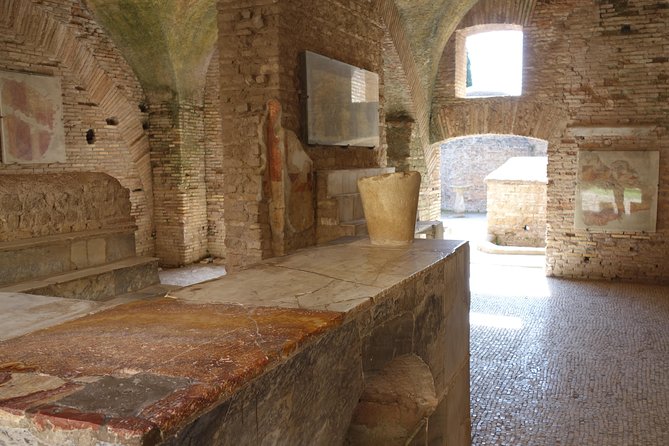
The guide is the biggest variable in an experience like this. The strongest reports consistently point to guides who make the ruins understandable without burying you in dates.
Alberto is praised for his organization, humor, pacing, and ability to explain the important buildings while giving the group options at the end. Cat is described as friendly and well informed about the site, with a good sense of timing. Rob is noted for storytelling and for watching the group’s comfort in hot conditions.
Laura, Barbara, Eduardo, and other guides have also been singled out for warmth, clarity, and enthusiasm. You cannot necessarily request a particular guide, but these names give you an idea of the level of interpretation the operator aims to provide.
There are less positive experiences too. One person preferred the site’s audio guide to a dry presentation, and another felt ignored while walking with a cane. These accounts are a reminder to judge the product fairly: the archaeological site is the reliable attraction, while the human quality of the tour depends heavily on the assigned guide.
Is $59.26 a fair price?
At $59.26 per person, the tour sits in a reasonable range for a guided half-day outing from Rome. The price includes the English-speaking guide, entrance to Ostia Antica, and train tickets in both directions.
That bundled cost matters. You are not paying separately for admission or trying to calculate local transport expenses during the day. You also receive route planning and interpretation, which are valuable at a site this large.
The price is less attractive if you prefer to explore in silence or at your own pace. You can reach Ostia Antica by train independently, and an audio guide is available at the site. A do-it-yourself visit may suit you better if you want several hours for photography, the museum, or less visited corners.
For most first-time visitors, I think the fee is justified by the ease of the trip and the context provided by a strong guide. The small group limit also makes it better value than a large group where questions and visibility can become problems.
Free cancellation is available up to 24 hours before the start time. Changes or cancellations inside that window are not refunded, and the minimum group requirement can affect departures.
Who should book this Ostia Antica trip?
I would choose this tour if you want ancient Rome beyond the city center, especially if Pompeii does not fit your schedule. Ostia gives you a complete Roman town without the long journey south, and the train ride keeps the cost and logistics under control.
It suits adults interested in archaeology, families who want a manageable outing, and anyone who learns better from stories than labels. Teenagers may respond well to the amphitheater, shops, and visible street plan, particularly if you explain that this is a real town rather than only a monument.
It is less suitable if you need step-free access, tire quickly in heat, or want to move slowly for hours. It is also not the best choice for someone seeking a private, highly customized archaeological tour.
Should you book it?
Book this tour if you want an efficient, guided introduction to a large ancient site and value having the train, admission, and route handled for you. The best guides turn Ostia Antica into a clear picture of Roman daily life, and the smaller group gives you a fair chance to ask questions.
Skip it and go independently if you want total freedom, an audio guide, or a full day among the ruins. For most people with four hours to spare in Rome, though, Ostia Antica is a smart change of pace, less crowded than the city’s headline sights and far more revealing than its modest price suggests.
FAQ
How long does the Ancient Ostia Antica tour last?
The experience lasts approximately four hours, including the train journey from Rome and back. The guided visit inside Ostia Antica takes about 2.5 hours.
Where does the tour begin?
The meeting point is at Piazza Ostiense 11, 00154 Rome, near the Piramide metro station.
Where does the tour end?
The activity ends back at the meeting point in Rome after the return train journey.
Is transportation included?
Yes. Your guide provides train tickets for the journey to Ostia Antica and the return trip to Rome.
Is the Ostia Antica entrance fee included?
Yes. Admission to the archaeological site is included in the tour price.
How large is the group?
The tour has a maximum of 12 people.
Is the tour offered in English?
Yes. The experience includes an English-speaking guide.
Is the tour suitable for people with limited mobility?
The tour requires a moderate level of physical fitness and includes uneven ground, stairs, and substantial walking. It may be challenging if you have limited mobility.
What is the cancellation policy?
You can cancel up to 24 hours before the start time for a full refund. Cancellations or changes made less than 24 hours before the experience are not refunded. If poor weather or an insufficient number of participants causes cancellation, you can choose another date or receive a full refund.
More Ancient Ruins Day Trips around Rome
- Athens: Cape Sounion & Poseidon Temple Sunset Half-Day Trip
★ 4.8 · 8,241 reviews - London: Windsor, Stonehenge, Bath, and Roman Baths Day Trip
★ 4.5 · 5,131 reviews - From Aswan: Abu Simbel Temple Day Trip with Hotel Pickup
★ 4.4 · 2,807 reviews - Fes: Volubilis Roman Ruins, Mouly Idriss, & Meknes Day Trip
★ 4.6 · 2,375 reviews
More Train Day Trips in Rome
- From Rome: Ostia Antica Guided Half-Day Trip by Train
★ 4.8 · 486 reviews - Venice Day Trip from Rome by High-Speed Train with Happy Hour
★ 4.5 · 445 reviews - From Rome: Day Trip to Venice by High-Speed Train
★ 4.6 · 352 reviews - From Rome: Pompeii and Naples Day Trip by High-Speed Train
★ 4.7 · 234 reviews
Just added around Rome
- Day trip Rome by car : Tivoli Unesco Villa D’este & Hadrian★ 5.0 · 56 reviews
- From Rome: Hadrian’s Villa & Villa d’Este Day Trip & Lunch★ 4.5 · 157 reviews
- Day Trip from Rome: Explore Pompeii & Sorrento Amalfi Coast★ 4.8 · 160 reviews
- Sorrento & Pompeii Day Trip from Rome Audio Guide Tour★ 4.2 · 50 reviews
- From Rome: Positano & Amalfi Coast Day Trip by Train & Ferry★ 4.6 · 225 reviews
- From Rome: Ponza Island Day Trip with Boat Excursion★ 4.7 · 278 reviews
- From Rome: Sorrento, Positano & Amalfi Coast Day Trip★ 4.5 · 340 reviews
- From Rome: Pompeii and Vesuvio Guided Day Trip with Lunch★ 4.3 · 126 reviews
Train & Cable Car Day Trips, compared.
From Milan: Bernina Train and St. Moritz Day Trip
Read our review →
Salzburg Sightseeing Day Trip from Munich by Rail
Read our review →
Bangkok: Damnoen Saduak, Train Market & Mahanakhon Day Trip
Read our review →

Day Trip to Bangkok Floating Market & Maeklong Railway
Read our review →
Krakow: Zakopane, Funicular, Cheese, and Highland Day Trip
Read our review →
London: South Downs White Cliffs Day Trip with Train Tickets
Read our review →